
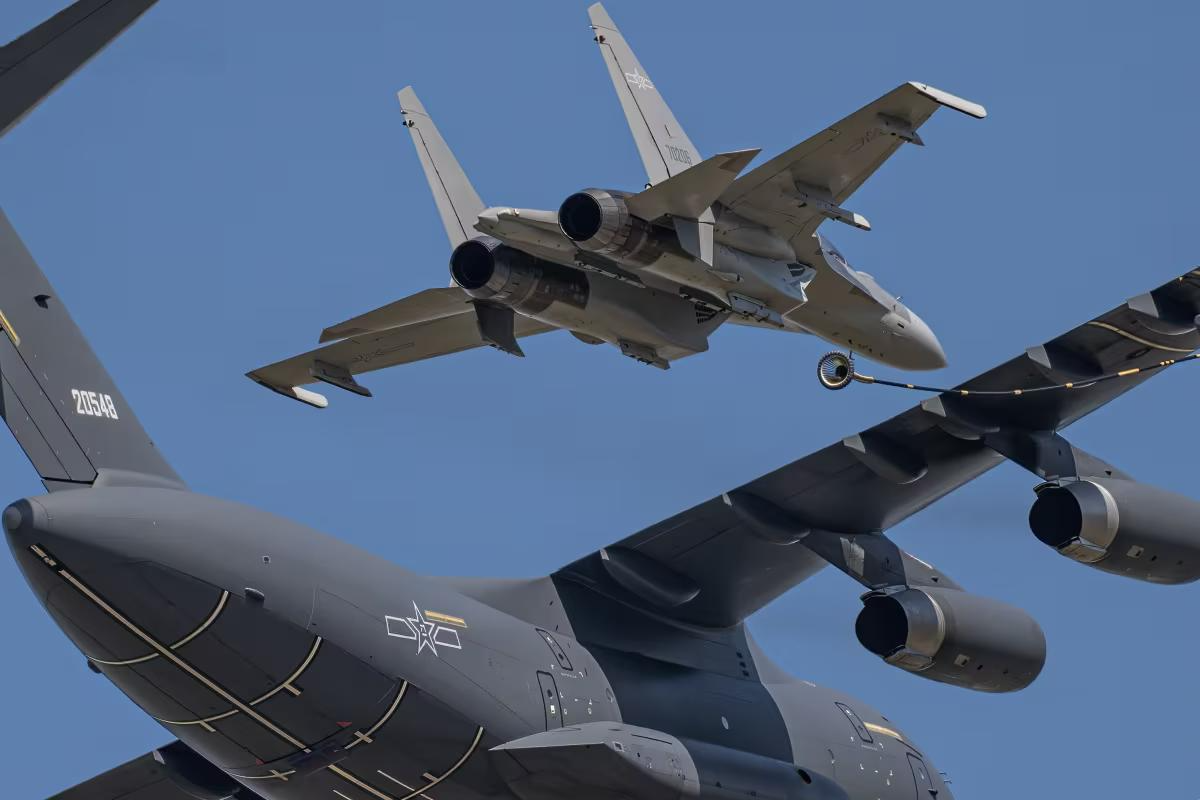
Artist's commentary
Flanker's 30 Years of History in China (Part 8)
Hello everyone! I found a very interesting episode of the well-known Chinese military talk show "羊羔特工队“ back in 2022 called "侧卫来华30年“. This episode discusses in detail the developmental and operational history of Sino-flankers, from the Su-27 to the J-16D, which is rarely seen or known on the Western internet. One of the hosts, Yankee, was famous for successfully predicting that China's 6th-gen fighter would have 3 engines and an MTOW of over 50 tons. His opinion article on J-36 was also allegedly verbally approved by the jet's chief designer, Dr. Wang Haifeng.
Therefore, I tried my best to translate this into English, as I believe his accounts on Chinese flankers' history carry some weight. This is part 8 of my translation. Hope you guys enjoy!
![[image]](https://i.redd.it/g0snlhcbj2jg1.png)
Flanker, reimagined
Ever since the PLAAF began fielding its multirole Su-30MKK in 2000, it has been no stranger to precision surface-strike operations. However, as the Air Force entered the second decade of the Century, it began to feel that its tactical aircraft fleet would be insufficient to conduct anti-surface and anti-ship operations against its most potent adversary. Specifically, the medium-weight JH-7A fighter-bomber, powered by a pair of licensed copies of 1960s Rolls-Royce RB.163 engines, would struggle to carry the latest and heaviest ordnance. And for the Su-30MKK, its Russian-made guided munitions and missiles had become obsolete at this point. To remedy this, the Air Force experimented with arming the MKK with indigenous YJ-88 anti-surface missiles, but the aircraft’s outdated avionics and fire-control system would prevent the missile from achieving maximum effectiveness.
![[image]](https://i.redd.it/5dqvwdlcm2jg1.png)
As a result, designers at Shenyang Aircraft Corporation combined the Su-30MKK's reinforced wings with a domestic avionics architecture derived from the J-11B, J-11BS, and J-15, leading to the successful development of the J-16, also known as the Hidden Dragon. This new Sino-Flanker, alongside the advanced J-10C and J-20 stealth fighter, has since then been known as the “Trio of Swordmen” of the PLAAF. In fact, the J-16’s maiden flight took place in October 2011, nine months after the first flight of J-20’s demonstrator. And understandably, after J-16’s emergence into the public eye, many questioned the value of continuing to develop a new fighter jet based on the Flanker airframe.
![[image]](https://i.redd.it/9h3a2ocmk2jg1.png)
But, as time has shown, J-16 proved itself to be indispensable to the Air Force, since it is the only advanced aircraft in the fleet capable of carrying and launching heavy, large-sized weaponry. That said, for operational security, publicly released photos of the J-16 almost never show it carrying anti-surface or anti-ship missiles. Speaking of the livery, the early batches of J-16 differ from the later ones: they are painted in dark grey, similar to the J-11s, and their insignias are coloured rather than being low-observable.
![[image]](https://i.redd.it/gj4h0utsy2jg1.png)
At first glance, many would perceive the J-16 as a Chinese copy of the Su-30. But while the J-16 and the Su-30 are both multirole, twin-seat Flankers, almost every aspect of the J-16 has undergone significant upgrades. In other words, it is the Su-30SM that the Russian Aerospace Force could never get their hands on. The one area where J-16 can perhaps outshine all of the contemporaries is its gigantic, 980mm-wide AESA radar, housed in its spacious nose cone. Since AESA radar consists of thousands of tiny T/R modules, all else being equal, the larger an AESA radar’s diameter is, the more powerful it will become, since there is the space to house more T/R modules. During the Su-27’s development, its nose cone was enlarged by design because the Soviets were behind the West in radar technology. As such, the nose of the Flanker must be large enough to accommodate a bulkier radar that could achieve a similar level of performance as smaller radars made in the West. In fact, if looking from a purely aerodynamic perspective, it would be more desirable if the Flanker’s nose cone could be shrunken. But given that such a large nose cone already exists, J-16’s development team took full advantage of it, installing a very large and powerful AESA radar so J-16 could decisively win in situational awareness against other 4.5-gen fighter jets. In fact, when facing the J-10C or even the J-20 stealth fighter in simulated combat, the J-16 retains its competitiveness thanks to its large AESA radar, which, under various modes, can still maintain a wide detection range. As such, appropriate tactics for the J-16 have also been developed.
![[image]](https://i.redd.it/4m7nsc4ll2jg1.png)
It was rumoured that when the first batch of J-16s entered service, the Air Force conducted a test flight to evaluate their performance. As the pilots turned on J-16’s ASEA radar, a pair of friendly J-7s, having just taken off, could be tracked at a startling 3-digit kilometers in distance. It was even more impressive given that the J-16’s ASEA radar was scanning downward amid increased surface clutter from the airport, not to mention the J-7 is not an aircraft with a particularly high RCS. Unfortunately, for the two J-7 pilots, it must have been a horrifying experience: the aircraft’s radar warning receivers suddenly issued alerts when their own radars showed no aircraft within a 2-digit km range or even possibly as far as 100 km. And to the credit of the J-7 pilots, since the PLAAF at that time had already begun Combat-Oriented Training (实战化训练) for its fighter fleet, they immediately dispersed and executed evasive maneuvers; yet, unsurprisingly, the J-16 could still maintain track of the J-7s. After landing, the J-7 pilots were notified that the unknown aircraft illuminating them in the air belonged to the “new-quality combat force”(新质战斗力), which referred to all advanced weapon systems, including the J-16.
![[image]](https://i.redd.it/cs9b5254n2jg1.jpg)
Another major area where J-16 sees major improvement is its human-machine interfaces, namely the design of its cockpit. It is well known that the Soviet aircraft’s cockpit is not the most user-friendly, and China’s J-11B and BS largely inherited it, other than the addition of LCD screens. Consequently, on J-16, Chinese engineers integrated many design elements from the cockpits of Western fighter jets, including advanced voice controls, visual cues, and communicative tools used between the two pilots. Add to that, fewer yet larger displays were also installed onto J-16’s cockpit, enabling the two pilots to cross-collaborate and manage the information flow more efficiently.
![[image]](https://i.redd.it/pv5lhl9hr2jg1.png)
When it comes to the well-known “heart disease” of Chinese fighters, the J-16 has seen several iterative improvements to its WS-10 turbofan engines across various batches, leading to steadily increasing reliability and a boost in total thrust. Such an increase in thrust would partially offset the extra drag brought by the elevated rear seat compared to single-seat Flankers. In addition, the range deficiency of the twin-sear Su-30MKK has also been rectified, as J-16 can now carry more than 10 tons of internal fuel, or about a 500 kg increase compared to Su-30MKK.
![[image]](https://i.redd.it/afdextksr2jg1.png)
Given the positive feedback from frontline units, J-16 has been produced in large numbers, surpassing its predecessor, the J-11 family. In the foreseeable future, J-16 deliveries may well exceed 10 batches, with each batch comprising around 20-30 airframes. The previous Chinese-made fighter jet delivered in more than 10 batches was the Shenyang J-8II, although each batch contained fewer airframes than the J-16. More importantly, in later batches of J-16, their avionics can be rapidly upgraded, similar to operating system updates on PCs and smartphones, allowing streamlined integration of new missiles and ordnance.
![[image]](https://i.redd.it/zll6a04cs2jg1.png)
As the J-16 claims the spotlight as the most advanced multirole heavy-hitter, another Flanker with considerable fanfare has made a surprise debut in the PLAAF. Indeed, the fierce debate over which one of them is the best Flanker has raged for well over a decade, especially outside of China. But after all, the PLAAF itself is arguably the most authoritative voice to make this judgment, as it operates both types of Flankers concurrently.
![[image]](https://i.redd.it/0ffckh80t2jg1.png)
Leave a comment