Artist's commentary
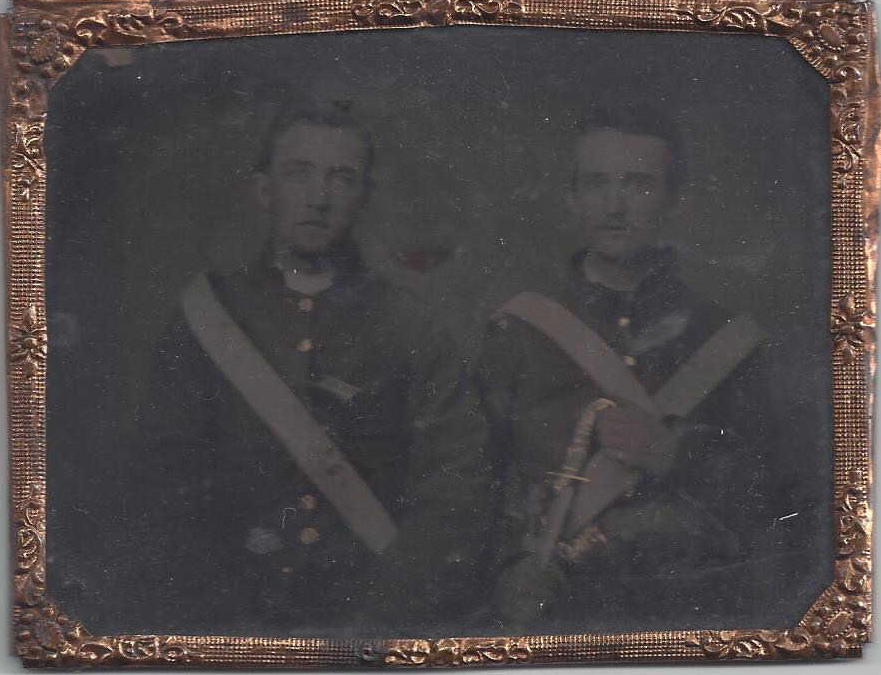
Miles Osborne Sherrill & brother James Albert Sherrill
Miles was a Corporal (19) in the Catawba Rifles, which later became Co. A of the 12th NC. Albert was in the same regiment & company.
At the Battle of Spotsylvania Courthouse, James was killed & Miles lost a leg. A long time after the war, Miles wrote down his experiences.
"My younger brother, James Albert Sherrill, who had been with us only six months, fell dangerously wounded just at the time the command was given to fall back. Of course he fell into the hands of the enemy; there, lying weltering in his blood, the enemy came on him, and instead of ministering to his wants, a brute in human form in uniform took his bayonet and stabbed the poor boy to death. I did not see this, but Alfred Sigmon, of Catawba County, who was also wounded, was an eyewitness to the tragedy. "
" I was shot in the first charge that was made at Spottsylvania Court-House, Virginia, early on the morning of the 9th day of May, 1864. The charge was made by our brigade, composed of the Fifth, Twelfth, Twentieth and Twenty-third N. C. Regiments, led by General R. D. Johnston. The charge was a success so far as the enemy in our front were concerned, but our lines were overlapped by Burnside's troops. Our regiment (the Twelfth) and our company (A), being on the extreme
right, were exposed to an enfilading fire clear across an open field; so we were exposed to a fire from front and from the right. The enemy had torn down a rail fence and made temporary breast-works in our front, from which our men drove them, but could not hold the position because Burnside's whole army corps was on hand, and could easily have cut off our little brigade; so General Johnston gave the command to fall back. As our troops fell back, Sergeant Silas Smyre (now county commissioner of Catawba) and Corporal E. G. Bost endeavored to carry me from the battlefield. They were so exhausted from marching and fighting that they could not hold me up so as to prevent the crushed leg from dragging on the ground. To prevent their being captured, I begged them to leave me to my fate. (May I never forget this act of kindness by these brave men, who risked so much for me.) I was in the broiling hot sun, without water, my canteen having been shot in the fight, and the water all run out.
I was concealed from the enemy by some shrubbery. Late in the afternoon I realized that I could not live without water. The loss of blood, together with the burning rays of the sun, made me feel that life was about to ebb out; so I called to the enemy and surrendered. Here I commenced the life of a prisoner, which lasted ten months. Besides the suffering from wounds, the humility, the loss of liberty, the absence of all friends and loved ones, no face but that of enemies, was just about as much as I could bear up under in my condition. In that hour home and friends would have been "a haven of rest" sure enough. The day following, May 10, 1864, when I was laid on the slaughter table, my eyes caught the sight of arms and legs piled on the ground - an indication of what I might expect. Dr. Cox, of Ohio, examined my leg. The only conversation that passed between us was this: I said, "Doctor, can you save my leg?" He replied, "I fear not, Johnny." Chloroform was applied, and when restored to consciousness I was minus one limb. I lay there in what was designated "a field hospital"
for two or three days without any further attention to the wound, and the result was the flies "blowed" the amputated limb, and when I reached Alexandria City, some days later, the nurse who dressed the wound found that I was being eat up by the vermin."
Leave a comment